Review of Pain to Power by Maruja
Who would have thought the saxophone could become a weapon, but in Maruja’s hands, it swings like a bat wrapped in barbed wire.
Maruja (not to be confused with the chocolate bar) has been steadily building a devoted fanbase while continuously experimenting with their sound. Now, ten years in, the members have spoken openly in interviews about a profound personal and collective journey toward spirituality, culminating in the release of their debut album, Pain to Power.
And spiritual it is, if your version of enlightenment involves caving in skulls and drinking the blood of the ultra-rich. Maruja have no interest in softening the message, and frankly the late-stage capitalist rage fits perfectly over the dense wall of sound they throw at you.
Bassist Matt Buonaccorsi told NME: “A lot of themes on this album, and I mean stuff that the four of us, our generation and people across the world are experiencing right now, are about seeing so much turmoil, war, corruption, greed, horror through the screens of our phones.”
The quality of Pain to Power lies mostly in its front half, where the more overtly political tracks like “Bloodsport” and “Look Down On Us” do their best work. What becomes clear by the fourth or fifth listen is the album’s descent into tracks that feel repetitive and less cohesive, mostly because of a saxophone that at times becomes like a mosquito on steroids. Even live, saxophonist Joe Carroll jabs the thing into the crowd, and much like the mosquito, you do not realise it got you until it is already too late.
“Complicit crossfire
No vision, live wire
Complicit crossfire
No vision, live wire”
“Bloodsport” jumps in with a stretched out leg. No frolicking around the themes they want to address, no, just a straight kick of post-rock into your face. The lyrics go straight into the subject of how we have made suffering and death into entertainment, with even the youngest on social media easily gaining access to videos of terrible crimes against humanity. We have become so used to hearing about genocide, murder and death that it is just another headline you forget about within ten minutes. The instrumentals themselves feel angry and violent, the twisted sounds in the opening seconds combined with moments of relentless drumming and a bass that sounds like it is being tortured. It is also the track that leans most into the rap-rock side of vocalist Harry Wilkinson, who sounds like he has a personal score to settle. The song opens up toward the end, the drums shifting into something closer to world music, that tik-tak rhythm creating a strange breathing room, while the saxophone punches its own way through as it always does. While it is not the album’s most replayable track, it is the perfect way to open it.
“Because a lot of the time, when a message is subjective, somebody can put their own personal interpretation on it, which will be integral for their state of mind in that moment. Whereas if I’m saying something as poignant as “They look down on us!”, that’s a message that everybody can relate to and everybody can come together and sing the chorus on because that’s how everybody feels.” – Harry Wilkinson on The Needle Drop
“Look Down On Us” is by far the greatest song on Pain to Power. Everything about it just fits. The political message is something almost all of us, except the top 1%, can relate to, because there is almost no feeling as painful as being looked down upon, treated like you are disposable. It is the most important lyrical statement on the entire album, and Harry Wilkinson puts it plainly: “The tech giants that tower over government laws… it’s an absolute abysmal parade right now that we’re experiencing, and everybody feels it, and everybody’s sick of it.” We all like to think that kings and monarchs are a thing of the past, but they simply evolved with the times, and Maruja are very aware of this.
“Corporations profit hard then cackle like some vultures
Picking bones through their teeth caught between the meat
See the blood dripping down to the claws on their feet”
These lyrics are sharpened by ten years of brooding, of finding out what they want to write about and what gives them the most energy on stage. And from personal experience, they have energy to spare. As mentioned before, the chorus is the cornerstone of the track, if not the entire album. Fun fact: Harry mentioned in an interview with Fantano that the hook was inspired by “Not Like Us” by Kendrick Lamar, without the Drake being a paedophile part, of course.
And it is not only the lyrics that impress. The song is built from two parts, separate jam sessions that create two completely different feelings, one of anger and one of hope, while still very obviously belonging to the same track. The saxophone is at its best here too, even when it goes blasting on the same two notes, because the rawness fits the lyrics like a glove. The same goes for Harry’s vocals, which feel more emotional and heavier than anywhere else on the album, a level of raw intensity the back half never quite manages to match.
“Saoirse is about resistance, and about the roots that tie us all together. We don’t choose where we are born, but we can choose to act. It’s our decisions that define us.” – Maruja
Very fitting with the album’s theme, Saoirse is an Irish feminine given name meaning “freedom” or “liberty” that emerged during the 1920s Irish War of Independence, tightly fused with the Irish Free State (Saorstát Éireann). It is refreshing to see a British, Manchester band draw on Irish influence for an album that is ultimately about oppression, blood and freedom.
Musically, “Saoirse” is one of the only tracks to break out of the Maruja formula, with the saxophone playing only a minor role, prominent in the opening but largely stepping back after that. It paints a far more emotional and fragile side of the band, almost as if they shed all the anger from the earlier tracks and are left feeling something closer to remorse. The string section on this track is the best decision Maruja could have made.
“It’s about letting go of these preconceptions that this culture has put upon us to make us fearful of one another, and to remind ourselves that we are actually all just here to learn from one another. Because everybody’s experience is different, so they all have a lesson to teach you. Sometimes you might not like the lesson, but it doesn’t matter. A difference of opinion shouldn’t mean that you should hate them, you know?” – Harry Wilkinson on The Needle Drop
“Born to Die” is perhaps the album’s most ambitious stretch, trying to carry the listener from the fury of “Look Down On Us” through the tenderness of “Saoirse” and into something more spiritual. It is a journey worth attempting, but at times the song tries the listener’s patience, and for a band whose greatest strength has always been their energy, the feeling that something is about to combust at any moment, it is the one track where that fuse burns a little too slowly.
“It’s almost like two albums in one, like the way that “Born to Die” finishes and then goes straight back into “Break The Tension”. And it’s like, there: you’re blasted back into this painful place because life will always have these peaks and troughs of…You might be doing well for a minute, but there’s going to be something around the corner that you’re not expecting that’ll bring you right back down, or there might be something happening in your family that’ll bring you right down.” – Harry Wilkinson on The Needle Drop.
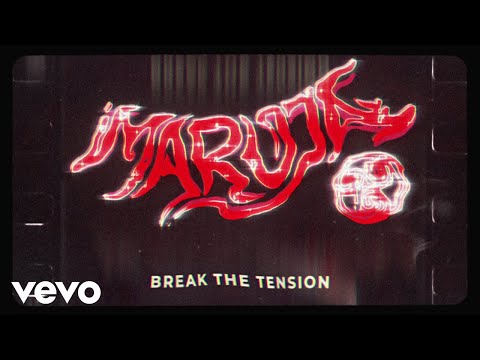
Coming off the slow and hopeful “Born to Die”, “Break the Tension” digs up the battle axe and starts another angry round of thrashing, dragging you back into the fight just when you thought you had caught your breath. While it picks up the tempo, it misses the spirit of the earlier tracks, lacking the spark that made the political fury of “Look Down On Us” feel so urgent. It is by no means a bad song, but it cannot break free from the repetitive nature Maruja start to get stuck in across the album’s latter half.
“Trenches” continues this feeling of a lack of urgency that made the first half of Pain to Power so gripping. It becomes clear by this point that Maruja run on a strong political message, and when that message shifts into something more spiritual, the music suffers for it. That said, the lyric “I see you in the Trenches” is strong enough that it deserved better, the kind of line that could have anchored a song in the same league as “Look Down On Us” if given the right fuel behind it.
“Like the olive tree, the Palestinian people have deep, resilient roots. They’ve resisted decades of forced displacement, military occupation, illegal settlements, and now enforced starvation.”
“Zaytoun” is almost certainly a reference to the people of Palestine, the word translating to “olive” or “olive tree” in Arabic, and carrying real weight given the repeated instances of settlers destroying olive trees that stood for hundreds of years as part of the native people’s heritage. The symbolism could not be more fitting for an album like this. But as an instrumental track, “Zaytoun” adds nothing new and exists purely as a buffer between “Trenches” and the album’s closing song, which for a name carrying that much meaning, feels like a missed opportunity.
“We are love in abundance and our courage can’t be tamed”
We have arrived at the final track of Pain to Power. “Reconcile” finally picks the spiked bat back up, but this time uses it to stabilize rather than destroy, making it easily the best song on the album’s latter half. It is a message of hope, and closing the album on this note feels like an act of kindness from Maruja. The track opens with the kind of lazy, smoke-filled drum groove you would expect from a late night jazz club, and for once the saxophone calms itself down, presumably to cool off after its extended career as a two-note weapon. It builds slowly, the mantra “Have no fear” repeating until it stops feeling like a lyric and starts feeling like something Harry has been carrying around for years. By the time it explodes into its final crescendo, you get the sense that this one hits him harder than anything else on the record.
An album that dares to be more political than most politicians, taking jabs, saxophone and all, at the ultra-rich, the ultra-violent, and the general scum of the earth. The back half loses its footing and repetition starts to creep in, but what Maruja have put together here is an impressive statement. And if the world manages to survive long enough, which Maruja seem doubtful about, the next barbed wire swing is going to leave a mark.
Album Artwork
Cover art by Mikey c Thomas
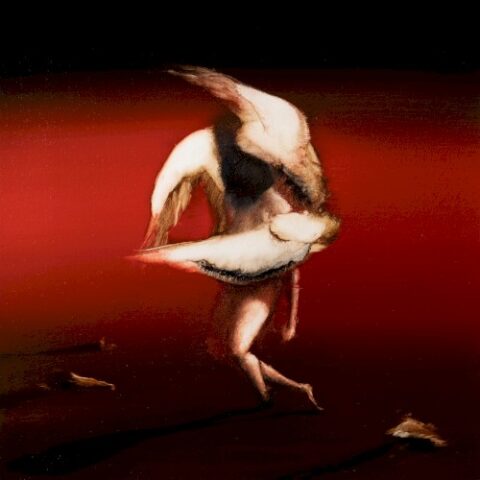
I have nothing but respect for Mikey Thomas. He did not only create an album cover that matches the music perfectly, he created individual paintings for each song, every single one fitting the tone of its track. Mikey described his process as inhabiting the world of the album, attempting "to draw out and crystallise some of the flashes" of an enormously rich and deep world that Maruja had created.
There is no official description of what is depicted on the cover, but to these eyes it looks like a winged figure, or perhaps a man moving so fast that his arms twist and warp with the speed, thrashing violently across the canvas with his feet barely touching the ground. It carries the energy of a medieval painting, something close to the dark, nightmarish world of Hieronymus Bosch. The colour alone does half the work, a dark gradient bleeding from deep red into pure black that could not fit the album's themes any better if it tried.
No text or description on the front cover was needed, and honestly it would have ruined it. This is a piece of art you could hang on a wall, and it feels historical, filled with emotion and entirely handcrafted. The music deserved artwork like this, and it got it.
Featured Tracks


editorial





No reviews yet
Be the first to share your thoughts on this album.