Review of Off the Wall by Michael Jackson
One of the most recognized and popular figures in history, ranking somewhere between Jesus Christ and Albert Einstein, had to start somewhere, and that start was his breakthrough solo album Off the Wall, his jailbreak from his Motown child-star days with The Jackson 5 straight into a mature and fully formed pop star.
So what started this legendary three-album run by the King of Pop? A big part of the credit has to go to Quincy Jones. It was either by fate or by luck that Michael was cast as the Scarecrow in The Wiz, the all-Black musical reimagining of The Wizard of Oz. The film was a box-office flop at the time, but it did have Quincy Jones as its musical supervisor. Michael Jackson and Quincy Jones must have had incredible chemistry from the moment they met, because not even a year later they created a beautiful blend of Quincy’s jazzy, old-school sensibilities mixed with the burning heart of a young talent who had a voice that really wanted to say something, a voice that had been held back by his Motown child-star persona.
The opening track, Don’t Stop ‘Til You Get Enough, just blasts you right in the face with warmth, joy, and so much damn funk my heart forgot to pump blood for a second. Just imagine this in 1979. You’re buying this record thinking, ah, another Michael solo project, but Don’t Stop ‘Til You Get Enough comes out of the gate swinging. It opens slow, with Jackson sounding almost insecure, stuttering and murmuring, before it explodes into a rich, full sound that makes you want to build a time machine and fly back to a true disco club to dance all night. The feeling gets even stronger when watching the music video, with Michael dancing in triplicate, surrounded by clouds, lights, and whatever 1979’s computers were capable of rendering.
“We take his stuff and take it to another level.” — Quincy Jones on Don’t Stop ‘Til You Get Enough
The track was one of three songs written by Michael Jackson himself. The melody first came to him while walking through his family’s Encino home, humming and singing it as best he could. He got his brother Randy to play it out on piano, and from there built a demo with help from his now equally famous sister Janet, and again Randy, using soda bottles, handclaps, and other bits of percussion. But on its own, it would never have become a hit without the help of the legendary Quincy Jones. (Am I being a fanboy of Quincy in this review? Yes. But he deserves it.) Quincy shaped the song alongside a lineup of stellar musicians, Greg Phillinganes, John Robinson, Louis Johnson, David Williams, David Foster, and Paulinho da Costa, who also helped bring the rest of the album to life. He didn’t just play a supporting role, he helped Michael make the key decisions. One of the most famous came when Michael wanted to cut the violin section at the beginning of the song, and Quincy said no. It’s now probably one of the defining moments on the album, if not in Michael’s entire career.
It’s no wonder the single shot to number one on the Billboard Hot 100 and held the top spot on the Billboard Soul Singles chart for six weeks. It went 5× Platinum and won Michael his first solo Grammy and first solo American Music Award. Not bad for a melody he hummed to himself walking around the house.
“Holy cow! I simply loved Rod’s musical feeling. Everything about it, Rod’s arrangements, his tunes, his songs, was exceedingly hip.” — Bruce Swedien, recording engineer, on Rod Temperton
Next up is “Rock with You,” written by Rod Temperton and originally titled I Want to Eat You Up before being toned down to fit Michael’s wholesome image. The song was first offered to Karen Carpenter, who turned it down, before Quincy, Michael, and Temperton shaped it into the sensual dance track that follows the opener. It’s silk-smooth, with tight basslines, ethereal synths, and a lush string section that makes it feel like a natural progression from “Don’t Stop ‘Til You Get Enough.” Where the opener explodes with energy, “Rock with You” settles into a groove that feels effortless, proving almost immediately that Off the Wall was not built on one incredible single, but on a fully realized sound.
Temperton is another key piece in Michael’s transition from child star to legendary pop figure. Quincy Jones had long been a fan of Heatwave, the band Temperton played keyboard for and, more importantly, wrote songs for. Quincy never got the chance to manage Heatwave, but he saw the potential in Rod. So when he started working on Michael’s first adult album, he approached Temperton, who agreed to fly out. Temperton always had a stack of unfinished songs lying around, and he brought a few to show Quincy. Three of them ended up making the cut: the title track “Off the Wall” (an insane fact on its own), “Burn This Disco Out,” and “Rock with You.” That alone says a lot about how important Temperton was to this record. He wasn’t just contributing songs, he was helping shape the sound of Michael’s transformation.
Another song written by Michael Jackson himself, Workin’ Day and Night continues this insane streak of groundbreaking songs. It’s my personal favourite on the album, thanks to its high energy, constant percussion, and how it absolutely destroys performed live. Every live version I’ve seen of this track is incredible.
“You say that workin’ / Is what a man’s supposed to do / And I say it ain’t right / If I can’t give sweet love to you”
Lyrically, it follows a man working himself to death for his girl because that’s what a man’s supposed to do, making it one of the more clever and original tracks on the album. You’re following a guy doubting his relationship, frustrated that he never gets to bring her any loving and only ever has to work. The verses are clearly about a girlfriend, but I’ve always read the chorus line itself, “you got me workin’, workin’ day and night,” as maybe a slight hint at Michael’s relationship with his father Joseph Jackson, which was more of a business arrangement than an actual father-son bond. With Joseph effectively owning his son from nine to five, Michael had to fit his solo projects, this record included, into whatever free time he had left, which wasn’t much.
As mentioned, the high-energy percussion creates a surreal happiness on this track. It blends with Michael’s breathing and riffing vocals to form a breath-and-clap rhythm, while the brass adds that feeling of the sun shining brightly on your life. I don’t know how else to describe this track. It’s just pure happiness.
Get on the Floor is the most straightforward disco song on the album. Co-written by Michael Jackson and Louis “Thunderthumbs” Johnson, you can probably already guess why he has that nickname (no, it has nothing to do with I Want to Eat You Up). All jokes aside, this song is a straight-up showcase of Louis Johnson’s incredible bass playing. It’s catchy, it’s groovy, it’s a perfect Off the Wall song.
The title track Off the Wall, which (fun fact) was reportedly also turned down by Karen Carpenter, is hard to wrap my head around. Either Karen had terrible disco taste, or she somehow knew these songs were destined for someone bigger. In my opinion, it’s the last track in the streak of unskippable, legendary songs before the album moves into a strong second half that just misses the spark of the first.
The disco powerhouse Off the Wall is an onion of music. So many layers you never notice them until the second, third, or fourth listen. It opens with the laughter of something eerie, a witch or an evil wizard, reportedly Michael himself, that feels almost like a nod to Thriller, or more accurately, an early sign of where Quincy and Temperton were already heading. The multi-tracked vocals overlap and surround you, creating a whole world of music that locks in perfectly with Louis Johnson’s tight bassline and, once again, the brass work that just radiates pure joy. We really need to thank Rod Temperton and Karen Carpenter more often.
“We shook hands amid a huge crowd of people, and he said, ‘You know, I’ve written a song for you.'” — Michael Jackson, Moonwalk
There’s a trend with the collaborations between Michael Jackson and Paul McCartney: the songs are always a little quirky and completely different from the rest of the album. I actually prefer the later The Girl Is Mine, not because it’s good, but because it’s so cringey it loops back around to fun. Girlfriend is my least favourite track on the album, though to be fair, it’s not exactly a fair fight to follow the previous five tracks. It would have worked better as a Beatles B-side. It’s fun, but it feels out of place.
“She’s Out of My Life, I’d been carrying around for about three years, you can feel the pain in it, you know. And I held on to it and finally something said ’this is the right moment to give it to Michael.’ And when we recorded it with Michael, I know it was an experience he’d never even thought about to sing in a song, ‘cause it’s a very mature emotion. And he cried at the end of every take, you know. We recorded about, I don’t know, 8-11 takes, and every one at the end, he just cried, and I said ‘hey, that’s supposed to be, leave it on there.'” — Quincy Jones, Off the Wall 2001 Special Edition interview
She’s Out of My Life isn’t quite my cup of tea, but I respect it for what it is. It’s a beautiful love song, drenched in that very specific late-70s, early-80s ballad style that hasn’t aged quite as well as the funkier tracks on the album. The music video amplifies that vintage feel, with Michael alone on a stool under a spotlight, ending on a spark of light as he cries, the kind of dramatic close that could segue straight into another 80s video. I still prefer the high-energy Off the Wall, but giving Michael the space to record something this far removed from his Motown child-star days opened the door for him to keep experimenting with emotional, lyric-focused tracks down the line.
I Can’t Help It starts and you immediately hear that Stevie Wonder was a major player in writing it. Originally meant for another classic, Songs in the Key of Life, and co-written with Susaye Greene of The Supremes, the track never made the final cut. It was later taken by Stevie’s sister Renée on a cassette and played for Michael, who loved it and added it to the lineup of Off the Wall.
The song isn’t just another case of how everything in the world is connected somehow, it’s also where the Jackson-Wonder fusion showed the world that Michael wasn’t only capable of writing and performing pop songs, but also jazz-leaning, funk-rooted material, an early hint at the constant shifts in sound that would define his later career.
When previously mentioning the second half of the album missing the spark, It’s the Falling in Love is the best example. It has most components the other tracks have, but it feels like Michael doesn’t feel the lyrics. It also has that Girlfriend hint of a very early-70s pop sound that hasn’t aged well. Fun fact, it’s another song written by other artists, in this case Carole Bayer Sager and David Foster (yes, the same Foster from Don’t Stop ‘Til You Get Enough), that Sager had already recorded herself before Michael and Quincy picked it up. Though I would have left this one in the garbage bin, if not for the catchy bassline.
The album ends with a song that brings us back to the high-energy, shining-sunlight feeling of the first half of Off the Wall. Burn This Disco Out, written by Rod Temperton, is a pure disco-funk song that makes the best possible use of Louis Johnson’s slap bass and a rhythm of tight stops and explosive starts.
Burn This Disco Out is the deep cut of the album. It was never released as a single, never performed live, and there’s very little interview material to go off of. In my opinion, that only adds to its mystique. It isn’t the most unique track or one most people return to, but it does end the second half on a more Off the Wall feeling than the rest of the B-side does.
Off the Wall might not be the best of Michael Jackson and Quincy Jones’ legendary trilogy, but it is the most pure version of Michael we’ll ever get. It served its purpose beautifully, marking the conversion of the Jackson 5 child star into the legendary pop figure he would become through the 80s. A few tracks bring the score down, sure, but few albums have ever matched this much pop-soul joy.
Album Artwork
Cover art by Mike Salisbury, Steve Harvey
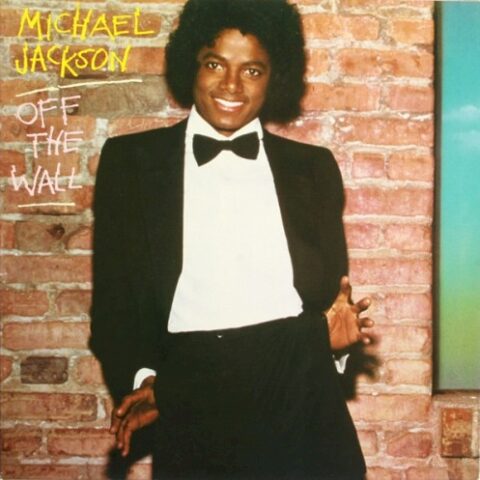
With an iconic breakthrough album comes an iconic cover. Off the Wall's artwork centers around Michael Jackson in a black tuxedo, a styling choice deliberately made to signal Michael's transition from Motown child star with The Jackson 5 into a more mature pop artist.
The movement in Michael's pose is just so fun and iconic, you can tell how much fun he was having shooting these photos. Take a look at the full album cover with Michael fully visible, the pose comes straight from his signature flow-like movements. The full-body shot also reveals fun details like the glittery socks, almost like a sneak peek of the sparkle that would take over his entire wardrobe in the years to come.
The brick background was the perfect choice for an album called Off the Wall. It's probably the first wall that comes to mind when you want something that looks great, not plain and easy like white drywall, but a wall with personality, even if it's just a gritty back-alley wall.
The album name is written on the wall in warm colors, likely crayon or added digitally later on. While it really adds personality, it does feel a bit cramped, especially with the placement of Michael and the window. The composition could have been shifted more to the right to give the title some room to breathe. These are just minor tweaks that would have made it not only an iconic album but also visually perfect, but when the music itself is so iconic and genre-breaking, what does it really matter?
Featured Tracks



editorial





No reviews yet
Be the first to share your thoughts on this album.